Last month the owner of a face-mask clay brand asked me one question: "We run two thousand tubes a day. Should we go fully automatic?"
That question cannot be answered as asked. "Two thousand a day" describes volume, not batch structure. Two thousand tubes as one batch and two thousand tubes as ten batches lead to opposite conclusions.
The short answer: for a plant running small batches across many SKUs, the real choice is not "semi-automatic or fully automatic." It is "how much does one changeover cost me?" Where that cost is low, a fully automatic machine can absorb small orders. Where it is high, automation becomes a liability you pay for every week.
Here is how the arithmetic works.
Most owners calculate capacity in tubes per day. That is fine for single-SKU, high-volume production. In multi-SKU production it misleads, because it hides the stops.
What matters is tubes per batch.
Take two plants, both running two thousand tubes a day. The first spreads that across four SKUs — five hundred tubes per batch. The second makes a single SKU all day. Identical daily output, completely different demands on the equipment.
Why? Because every SKU change stops the machine.
What happens during that stop: swap the sealing dies, reset the fill volume, adjust sealing temperature, flush the hopper and product path, run a few test tubes and check them. Done well, that sequence takes a little over an hour. Done slowly, three to four hours.
Five hundred tubes per batch, two hours of changeover. Two thousand tubes per batch, the same two hours. Spread over the batch, the changeover burden on the first plant is four times heavier per tube.
So the first number is not daily output. It is average batch size.
Most buyers assume the premium is in the machine itself. The price difference is only the first cheque. What really separates the two options is the cost of setup and changeover.
Think of it as vehicles. A semi-automatic machine is a panel van: it carries less, but it can turn around anywhere and stop whenever you want. A fully automatic machine is a coach: fast and efficient once it is running, but it needs space to turn and a proper stop to unload.
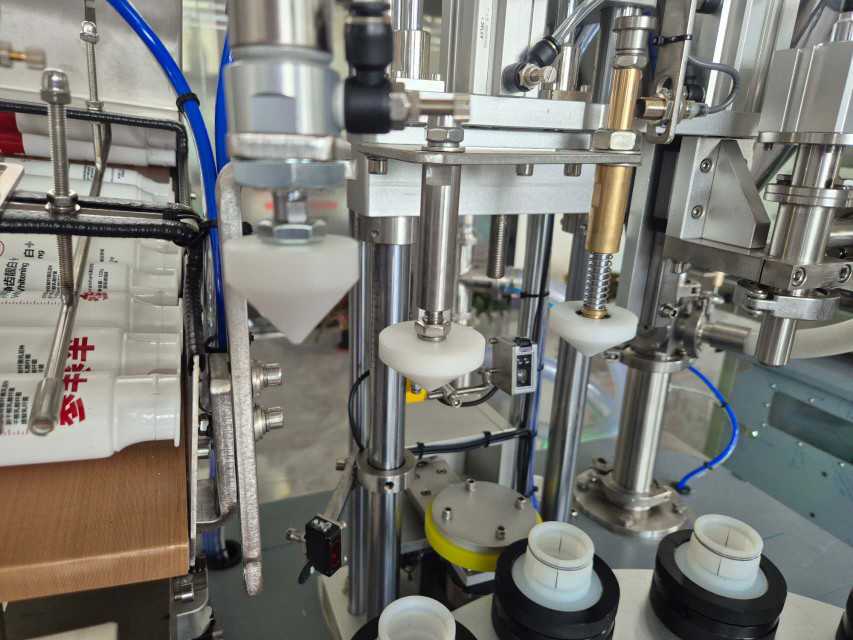
On a fully automatic tube filler, every motion is choreographed across servo axes, pneumatics and sensors. Change one parameter and the sequence shifts: alter the fill volume and the filling time must follow; alter the filling time and the indexing rhythm must follow; alter the rhythm and the sealing dwell is suddenly too short.
Changing a format on a fully automatic machine is therefore not editing a number. It is re-establishing the timing chain.
A semi-automatic machine is far simpler. The operator loads the tube and presses a foot switch; the machine only fills and seals. A format change means a new fill volume and a different sealing die — fifteen minutes or so and you are running again.
That is the crux: at small batch sizes, the efficiency advantage of full automation has not yet been earned, while the changeover penalty has already been paid.
Having outlined the weakness of full automation, the weakness of semi-automatic deserves equal time.
The capacity ceiling of a semi-automatic machine is the operator.
One person loading tubes, pressing the foot switch and removing finished tubes can handle 15 to 25 tubes a minute when experienced — 900 to 1,500 an hour. Over a seven-hour effective shift, that is 6,000 to 10,000 tubes.
For a small plant, that is enough. For a mid-sized one, it is not.
More important is consistency. Manual work has a rhythm of its own: morning differs from afternoon, Monday from Friday, and an experienced hand differs sharply from a new one.
The same operator who seats tubes perfectly and seals them centered for the first two hours will slow down by the fourth. Tubes go in slightly off-axis, seals land slightly off-centre, and the reject rate climbs. This is not an attitude problem. It is physiology.
The hidden cost of semi-automatic operation is therefore scrap and rework: the crooked seal that has to be pulled out, the overfilled tube that has to be wiped down. All of it is manual labor.
A rough planning figure: semi-automatic reject rates typically run 30% to 100% higher than fully automatic ones, depending on tube diameter and operator skill. Small-diameter, thin-wall tubes widen the gap.
Put batch size and changeover frequency together and three zones appear.
|
Average batch size |
Changeovers per day |
Recommended setup |
Main reason |
|
Under 500 tubes |
More than 3 |
Semi-automatic or bench-top unit |
Changeover cost dominates the batch |
|
500–3,000 tubes |
1–3 |
Semi-automatic with quick-change tooling |
Balances flexibility and throughput |
|
Over 3,000 tubes |
1 or fewer |
Fully automatic |
Changeover amortizes; efficiency advantage appears |
This table draws the lines coarsely. Three variables move them.
The first is tube diameter. Wide diameter variation means expensive die changes, so the break-even point shifts to the right. A narrow, standardized diameter range shifts it to the left.
The second is the product. Moving a paste from one fragrance to another demands a thorough clean, and cleaning can take longer than the die change. A liquid that rinses clean quickly shifts the break-even point left.
The third is order stability. The less predictable the order book, the more you should lean semi-automatic, because a semi-automatic machine is cheap to stop and cheap to restart.
One more variable is often overlooked: who does the adjusting. A format change on a fully automatic machine requires re-timing the sequence, and someone has to understand it. On a semi-automatic machine it is a number and a die set that most operators can handle. In a plant with one or two experienced technicians and high staff turnover, this variable outweighs the other three. A machine nobody can set up is a bigger problem than a machine that cost too much.
In practice, few plants have only large orders or only small ones. Most have both.
So what do you do when the big order needs efficiency and the small order needs flexibility?
The first option is two machines. A fully automatic unit runs the volume SKUs; a semi-automatic unit takes small orders and samples. Two machines can cost less than one highly specified automatic line, and they cover far more ground.
The second option is full automation plus quick-change tooling. Compress the changeover and the automatic machine can handle small batches too. In the industry a format change anywhere from thirty minutes to two hours is normal; quick-change designs bring it under ten minutes. Jiarren's five-minute changeover on aluminium tube sealers is built in exactly this direction — reduce the cost of the switch and the machine's useful range widens.
The third option is outsourcing. For SKUs with batches too small to run economically on your own line, place them with a contract filler. It is an uncomfortable sentence for an equipment supplier to write, but for a small plant it is the honest one. A machine exists to make money, not to prove a point.
There are situations where small batches should still go fully automatic.
The first is a hard hygiene or consistency requirement. Pharmaceutical tubes and aseptic filling get worse with every manual intervention: more contamination risk, more batch-to-batch variation. This is not a scenario for saving money on equipment by citing small batches.
The second is labor availability. In some regions experienced operators are increasingly hard to hire and harder to keep. A semi-automatic line depends on them; when they leave, output collapses. Full automation carries higher fixed cost but far less dependence on individuals, which is the more stable position over time.
The third is customer audit requirements. Some brand owners assess automation level, in-line inspection and data records during a factory audit. That is not a capacity question. It is a question of whether you qualify as a supplier at all.
The fourth is high unit value. On a product worth tens of currency units per tube, a one-point difference in reject rate is serious money, and the stability of full automation is worth far more than the price gap.
Back to the opening question: two thousand tubes a day — should you go fully automatic?
Here is a method you can actually use. Do not compare machine prices alone. Add these three lines.
First, changeover cost. How many times a day, how long each time, and what labor and lost output that represents. Multiply across a year.
Second, scrap cost. The reject-rate gap between the two options, multiplied by unit value and annual volume.
Third, labor cost. Semi-automatic needs more operators; fully automatic needs a few technicians. Compare the annual wage bill.
Add the three, then set them against the price difference, over a five-year horizon.
Most small-batch, multi-SKU plants discover two things: the hardware price gap is smaller than they assumed, and the changeover and scrap losses were badly underestimated.
Occasionally the reverse happens. Some plants find that, at their batch sizes, the changeover losses on an automatic line would run to roughly half the price of the machine every year.
Two further costs are routinely forgotten.
The first is ramp-up. A new machine takes two to four weeks from installation to stable output, during which capacity is discounted, rejects are high and the crew is still learning. Semi-automatic machines ramp up quickly; automatic ones take longer. If the machine was bought to take on an order, the ramp-up period belongs in your delivery promise.
The second is the cost of managing people. One more operator means one more set of tooling, one more training cycle, one more variable in the shift plan. That money never appears on a quotation, but it appears in the monthly report.
Rather than hand you numbers that belong to someone else's plant, here is the structure. Fill in six lines and the answer usually emerges on its own.
Then look at two ratios.
If annual changeover loss exceeds half the price difference, full automation will be held back by changeovers on your line. Either compress the changeover time first, or choose semi-automatic.
If annual scrap loss exceeds half the price difference, the problem is not the level of automation but the stability of quality. The answer lies in sealing monitoring and in-line inspection, not in agonising over semi versus fully automatic.
If neither ratio is high, decide on budget and on the labor you can actually hire. Do not over-engineer.
The point of the worksheet is not a precise answer. It is to replace the vague feeling that "automatic looks more advanced" with two numbers you can put on the table in a management meeting.
About Guangzhou Jiarren Automation Equipment Co., Ltd.
All of this arithmetic eventually lands on a specific proposal. The same batch structure, configured by different suppliers, produces different numbers — which is why the supplier's engineering depth matters as much as the price list.
Guangzhou Jiarren Automation Equipment Co., Ltd. has spent 15 years developing and manufacturing filling machinery for the personal care and chemical industries and holds more than 10 core patents in filling technology. The company ranks among the top three tube filling and sealing equipment suppliers in Guangzhou. Its range covers tube sealing machines, plastic-tube and aluminium-tube filling and sealing machines, dual-chamber tube fillers, ultrasonic tube filling and sealing machines, liquid and paste filling lines, gynecological gel fillers and vial filling and capping machines. The factory covers more than 3,000 m² and runs four to five production lines, staffed by 11 to 15 technicians with over a decade of experience each, with daily output reaching 30,000 units. Equipment sells across China and is exported to Europe, the Americas and Southeast Asia.
Aluminium tube sealing is where Jiarren is strongest. Its machines use a quick-change tooling system that completes a diameter change in five minutes — close to ten times faster than the industry average — while an intelligent monitoring system tracks sealing temperature and pressure in real time and stops the machine automatically when either drifts out of range, cutting scrap at the source. Stock machines and spare parts are held in quantity: custom builds typically ship within three to seven days, and small in-stock machines within twelve hours.
The company's philosophy — customer first, dependable service, quality first, satisfactory price — is backed by customized line design based on each customer's floor plan and process flow, a one-hour response commitment, and a service team that can be on site within 24 hours, keeping downtime losses to a minimum.
The answer is in your order book, not in the catalog
Semi-automatic or fully automatic is not a question of grade. It is a question of fit.
Two thousand tubes a day as a single batch: automation saves labor and stabilises quality. Two thousand tubes a day across ten batches: only a semi-automatic machine keeps moving.
The decision comes down to two numbers — average batch size, and changeovers per day. Put them in, and the answer largely writes itself.
And if those two numbers are still moving, the first task is not choosing a machine. It is understanding your order structure well enough to know what you are buying for.