In the tube packaging production process, the quality of the seal directly affects the product's sealing performance, appearance, and market acceptance. Many production colleagues have encountered such a tricky problem: irregular wrinkles always appear after tube sealing. Even after replacing tubes of different batches and specifications, the problem still persists. This indicates that the root cause of the malfunction is likely not the tube itself, but the core components of the tube sealer. Today, we will help you clarify your thinking and quickly locate the faulty components in the form of "question list + accurate answers."
Core Question 1: Is the pressure block of the sealing mechanism faulty if the pressure is uneven during sealing?
This is the key component that is most likely to be suspected first, and the answer is usually yes. The sealing pressure block is the core component that directly contacts the tube and applies pressure to complete the sealing. Once it malfunctions, it will inevitably lead to unbalanced pressure transmission and thus wrinkles.
Specifically, there may be three situations: First, the surface of the pressure block is worn or deformed. For example, after long-term use, burrs appear on the edge of the pressure block, the surface becomes uneven, or the shape of the pressure block changes due to high temperature or impact. In this case, it cannot form a uniform fit with the tube surface during sealing, and excessive or insufficient local pressure will naturally cause irregular wrinkles. Second, the installation position of the pressure block is offset. If the left/right or upper/lower pressure blocks are not on the same horizontal line, or deviate from the contact center of the tube, "one-sided force" will occur during sealing, and the tube will be unevenly stressed, resulting in wrinkles. Third, the pressure adjustment mechanism of the pressure block fails. For example, the pressure spring ages or the air cylinder leaks, causing the pressure applied by the pressure block to fluctuate, making it impossible to maintain a stable sealing pressure.
Solution: First, stop the machine to check the surface of the pressure block. If there is wear or deformation, replace it with a new one in time. Then, calibrate the position of the pressure block with professional tools to ensure that the pressure blocks on both sides are aligned. Finally, test the pressure adjustment mechanism, replace the aged spring or repair the leaking air cylinder to ensure stable pressure output.
Core Question 2: If the tube always "runs off" during transportation, could the positioning and conveying components be faulty?
It is entirely possible. The prerequisite for good sealing quality is that the tube maintains a stable and accurate posture during the sealing process. If there is a problem with the positioning or conveying components, the tube will shift or tilt at the moment of sealing. Even if the pressure of the pressure block is uniform, wrinkles will still occur due to the incorrect position of the tube.
Common fault points include: First, the conveying track is worn or the spacing is improper. After long-term use, grooves appear on the inner side of the track, or the track spacing does not match the tube diameter, causing the tube to shake left and right during transportation and fail to enter the sealing station accurately. Second, the positioning fixture is loose or damaged. The function of the positioning fixture is to firmly fix the tube during sealing. If the clamping force of the fixture is insufficient, the position is offset, or the surface is worn, the tube will shift under the sealing pressure, leading to wrinkles. Third, the conveying speed does not match the sealing speed. If the conveying speed is too fast, the tube enters the sealing process before being fully positioned; if the conveying speed is too slow, the tubes accumulate in the track, which will affect the stability during sealing.
Solution: Measure the track spacing and compare it with the tube diameter, replace the worn track or adjust the spacing. Check the clamping force and position of the positioning fixture, tighten the loose components or replace the damaged fixture. Calibrate the conveying speed and sealing speed through the equipment control system to ensure that they are coordinated and consistent.
Core Question 3: Is the heating component faulty if the sealing temperature fluctuates?
Yes, the failure of the heating component is an important hidden factor leading to sealing wrinkles. The principle of tube sealing is to heat the material at the tube opening to a molten state, and then form it by pressure extrusion. If the heating temperature is unstable, the melting degree of the material will be inconsistent. Some areas are over-melted and prone to stretching and wrinkling, while some areas are under-melted and cannot fit closely with the pressure block, which will also cause irregular wrinkles.
Specific fault manifestations are: First, the heating tube or heating plate is aged or damaged. The failure of some heating elements will lead to uneven temperature distribution in the sealing area, resulting in "local overheating" or "local underheating". Second, the temperature sensor is faulty. The sensor cannot accurately detect the sealing temperature, leading to misjudgment of the temperature control system, and thus the temperature output of the heating component fluctuates. Third, the temperature control instrument is faulty. The damage of the internal circuit of the instrument will lead to a large deviation between the set temperature value and the actual output value, making it impossible to achieve constant temperature control.
Solution: Use a temperature detector to detect the temperature distribution in the sealing area, locate and replace the damaged heating tube or heating plate. Calibrate the temperature sensor, and replace it directly if the calibration is invalid. Inspect the temperature control instrument, and repair or replace it in time after confirming the fault to ensure the accuracy of temperature control.
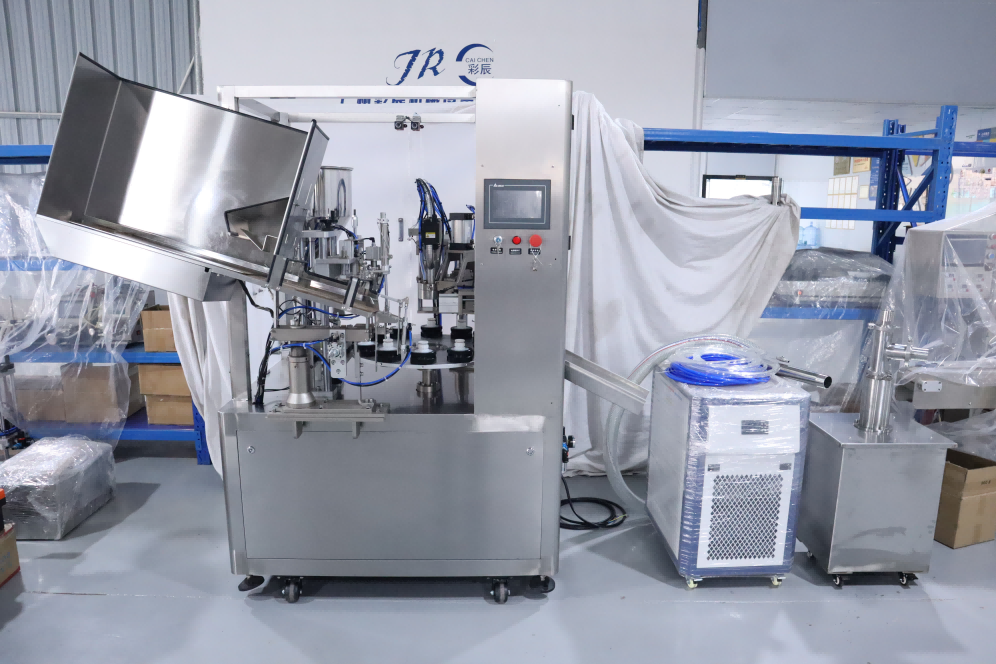
Core Question 4: Is the air pressure system faulty if the tube "bulges" at the moment of sealing?
For tubes that require air inflation to assist in sealing (such as some cosmetic and food tubes), air pressure system failure will indeed cause wrinkling problems. This type of tube needs to be filled with an appropriate amount of gas to maintain the shape of the tube body during sealing. If the air pressure is unstable, "bulging" or "collapsing" will occur, which will lead to sealing wrinkles.
Possible causes of the fault: First, the inflation nozzle is blocked or leaking. Blockage of the inflation nozzle by foreign objects will lead to insufficient inflation, and the insufficient internal pressure of the tube will easily cause collapse; poor sealing of the inflation nozzle will lead to gas leakage during inflation, which also cannot maintain stable pressure. Second, the air pressure regulating valve is faulty and cannot accurately control the inflation pressure. When the pressure is too high, the tube expands excessively and is prone to wrinkles when squeezed during sealing; when the pressure is too low, it cannot support the tube body. Third, the performance of the air pump declines, and the output pressure of the air pump is unstable, leading to large pressure fluctuations in the entire air pressure system.
Solution: Clean the foreign objects in the inflation nozzle, check and replace the sealing ring to solve the leakage problem. Calibrate or replace the air pressure regulating valve to ensure that the inflation pressure is accurately controllable. Maintain the air pump, and replace it with a new one if its performance cannot be restored.
Core Question 5: If wrinkles still exist after checking all the above components, which easily overlooked components could be the cause?
If there is no obvious fault in the above core components, you can focus on checking the following two easily overlooked detailed components:
First, the guide wheel of the tube sealer. The guide wheel is responsible for pre-positioning and posture correction of the tube before it enters the sealing station. If the guide wheel is worn, loose, or the spacing is improper, the tube will enter the sealing station with a skewed posture. Even if the subsequent positioning components try to adjust, slight deviations may occur due to inertia, eventually leading to wrinkles. Solution: Check the wear of the guide wheel, tighten the loose components, and adjust the spacing of the guide wheel to match the tube diameter.
Second, the timing belt or chain of the transmission system. Various components of the tube sealer (conveying, positioning, sealing, heating) need to rely on the transmission system to maintain synchronous operation. If the timing belt or chain is loose or worn, it will cause deviations in the coordination of the components. For example, when the sealing pressure block is pressed down, the tube has not yet been fully in place, resulting in wrinkles. Solution: Check the tension and wear of the timing belt or chain, and adjust the tension or replace the worn components in time.


